
Aaron Hinton
The mind behind alfred
Aaron Hinton was our first Skillbridge recruit and he has completely impressed us continuously with his achievements. Not only does he mark our first Skillbridge success, but he has also introduced new technologies and products that we wouldn’t have been able to develop without him. First, let us share with you the interview we conducted with him.
What was your journey before PMAT?

Before PMAT, I spent five years in the military, specifically in special warfare. That environment shaped a lot of who I am today. During that time, I had hands-on experience with drones and saw firsthand how powerful they could be in offensive operations. But I also saw a gap: most of the focus was on kinetic capabilities, and very little was being done to explore how drones could be used for lifesaving missions. That contrast stuck with me. I wanted to bring a different mindset to the table. I wanted to see advanced technology like AI and robotics, used for detection, rescue, and humanitarian applications. Academically, I studied Applied Mathematics in college, which naturally led me to develop an interest in AI and machine learning. My dad worked closely with data scientists, so I was exposed to the field early on and it always intrigued me. That curiosity grew over time, and I eventually applied for a Master’s in Analytics with a focus on AI and ML. That combination of operational experience and technical training put me in a great position to contribute at PMAT, where real-world missions and technology intersect.
What do you like to do outside of work?
When I’m not working, I’m usually either outdoors or building something. I love traveling. Whether it’s hopping continents or just road-tripping out west. I’m big on camping, hiking, and exploring the kind of landscapes that make you stop and just take it all in. Don’t get me wrong, I love being around people, but the ultimate reset for me is being out in nature, witnessing the beauty the world has to offer, and just sitting with it for a while. I also spend a lot of time working on side projects. Lately that has been AI-based apps or personal assistants I can run on my own devices. It’s a fun way to blend curiosity, learning, and creativity into something tangible.
What motivates you?
I’m motivated by progress. Whether it’s learning a new framework, coming up with an idea for an app and creating a prototype, or just solving something that seemed impossible a few days ago, I get a real buzz from moving the needle forward. I see progress as learning and executing. If you learn something, but don’t practice it, then you’re only accomplishing half of what you could. The full picture is learning something and then immediately putting it into action. I also like being part of teams that have a clear mission. When the people around me are passionate and pushing towards progress, it lights a fire and I start obsessing over the goal.
Tell us about the SkillBridge process.
The SkillBridge program was honestly one of the best opportunities I’ve had. It gave me a soft landing out of the military and into a tech career without having to worry about losing momentum or income. I was able to fully commit myself to learning and contributing at PMAT while still technically on active duty. I wasn’t job hunting under pressure or jumping into a foreign environment. I had the time and space to build trust with the team and understand the work at a deeper level before committing to a full-time position. I would say it definitely worked out for me because I ended up working for a company I wanted to, doing what interests me.
Why stay with PMAT?
I chose to stay at PMAT because it checked the boxes: meaningful work, strong mission alignment, a great team, and leadership that listens. I did not want a cookie-cutter job. I wanted to build systems that matter, work with people who are sharp, and be constantly learning. PMAT offers that. One of the biggest factors in my decision to stay was the people. Everyone I work with is passionate, supportive, and willing to help to solve hard problems. That kind of environment is rare. Leadership is also very open, which was something I very much appreciated while in the military. Whether it’s a technical idea, a process improvement, or just a quick one-on-one conversation, they make time and care about the work and the people behind it.
What excites you about your position?
What excites me most is the ownership I have over projects like ALFRED (Autonomous Life Finding and Recovery Emergency Drone). I’m not pigeon-holed into just coding. I’m helping design systems, tackle new challenges, and shape where technology goes next. I am also excited to be part of the Advanced Technologies branch of PMAT, where I can work with implementing cutting edge technology into the real world to solve problems in novel ways.
What are your accomplishments thus far?
The biggest accomplishment so far has been leading the development of ALFRED (Autonomous Life-Finding and Recovery Emergency Drone). It’s an AI-enabled drone system designed to detect people overboard in maritime environments. This is something I personally believe could have a huge impact on both defense and civilian applications. We’ve gone from raw datasets and model concepts to working prototypes that run real-time inference on both laptops and can run on edge devices like drones.
ALFRED is built for real-world deployment. It detects human objects in live video feeds, operates in varying lighting and environmental conditions, and is designed to scale. We will start with a single drone and then hopefully progress to a coordinated swarm. The ultimate goal is to transform how we approach maritime safety and search-and-rescue missions. I want ALFRED to be a tool that saves lives and gives people peace of mind, knowing we’re using the best technology available to prevent the unthinkable.
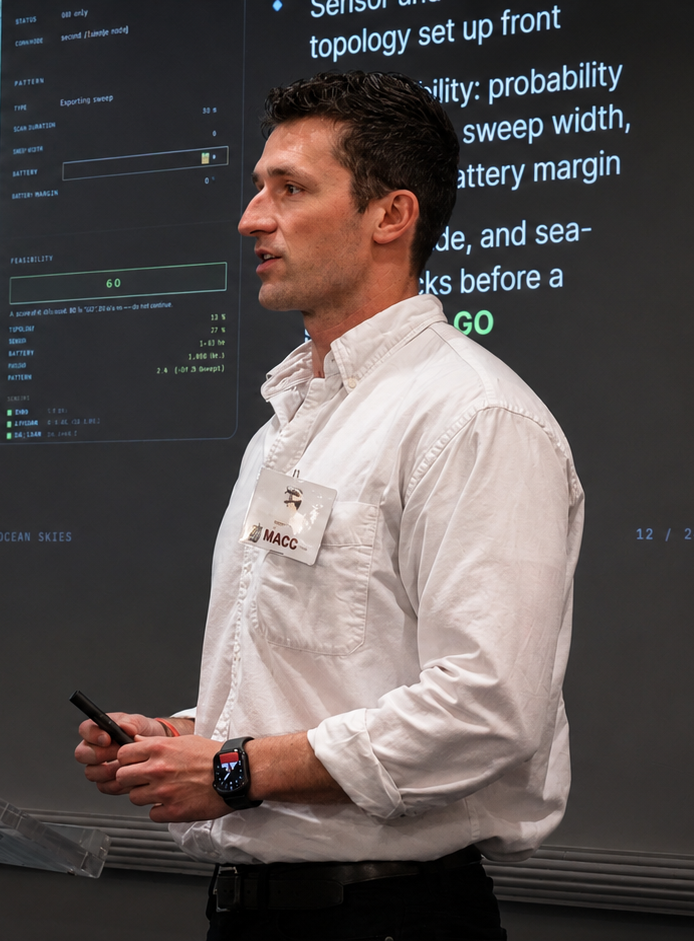
PUBLICATIONS
Authors Hinton, A and Sanderson, E (2025). Joint Terminal Attack Controllers in the Autonomous Age.
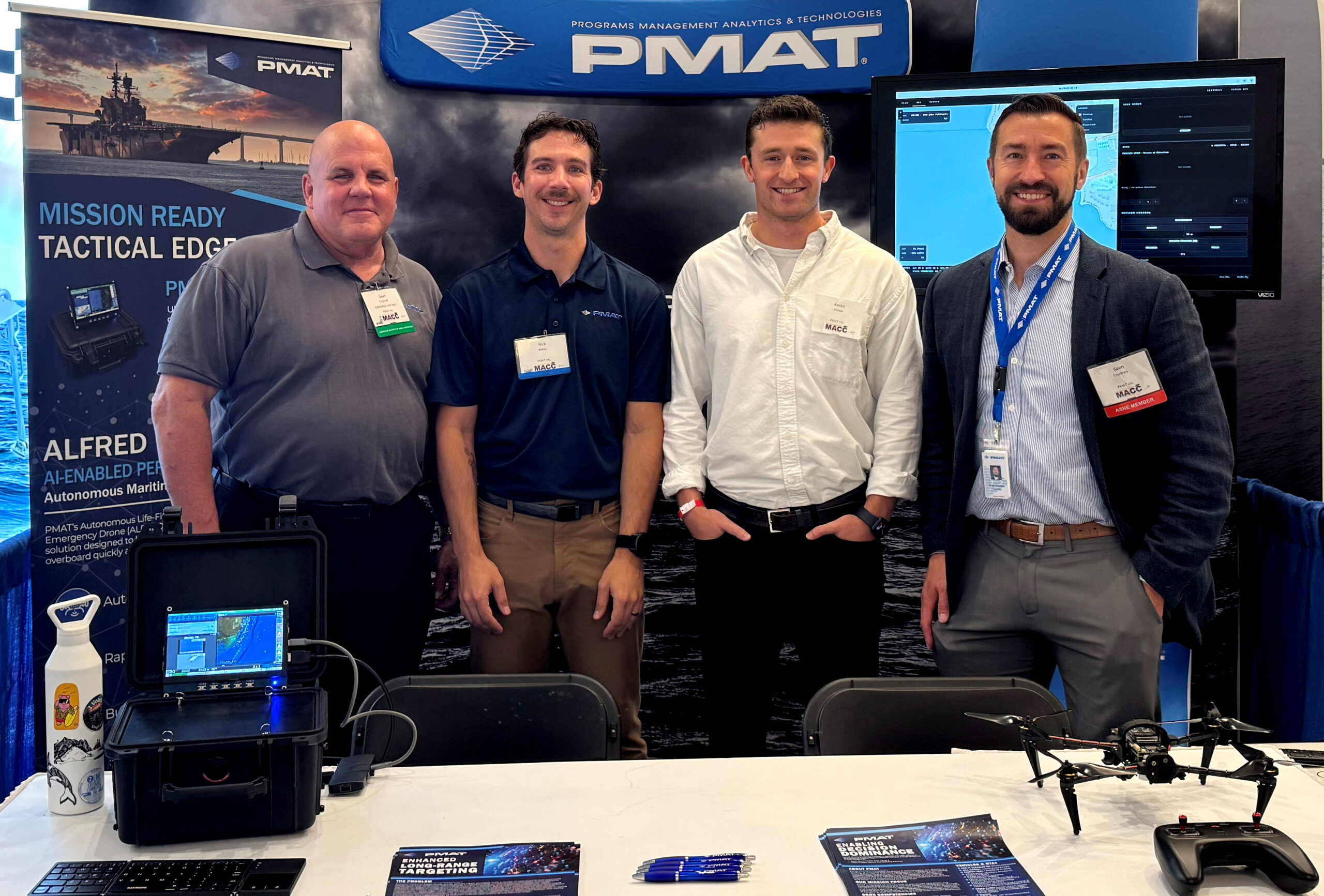
With PMAT’s support and the pace of AI innovation right now, development has been incredibly fast. I’ve had the freedom to test ideas, fail forward, and iterate quickly. It’s rare to find that kind of balance between structure and creativity, and I feel really fortunate to be part of something this meaningful. I’m excited to see where ALFRED goes next, and what else we can build along the way.
PMAT will soon be launching a product page with more information on ALFRED and how it can best suit your needs! Be sure to check out our LinkedIn and Site often for updates!